
As an Amazon Associate, Rad Garden earns from qualifying purchases.
A vegetable garden layout is your plan for where the beds, rows, and paths go before anything gets dug or built. Get it right on paper and the rest goes smoothly.
Get it wrong and you find out later, when you can't reach the middle of a bed, the wheelbarrow won't fit down the path, or the lumber is already cut.
New to this? A basic vegetable garden layout for beginners doesn't need to be fancy. It's just beds you can reach and paths you can walk. This guide walks you through each step, whether you're digging in-ground rows or building raised beds. It also introduces Rad Garden's new free garden planner, which lets you draw your garden to scale and catches spacing mistakes on screen, before you build anything.
Quick Answer: How to Plan a Vegetable Garden Layout
- Measure your space and mark fences, gates, and anything you can't move.
- Keep beds 4 ft wide if you can reach in from both sides, or 2 ft wide if one side is against a wall or fence.
- Leave about 3 ft of path between beds.
- Pick a simple layout and draw it to scale before you dig, build, or buy anything.
- Count your beds by size to work out how much lumber, kits, and soil you need.
Plan Your Vegetable Garden Layout Before You Build
Good vegetable garden design starts before you turn a shovel of soil or buy a single board. Watch for these common mistakes:
- Beds too wide. You can't reach the middle without stepping on the soil.
- Paths too tight. No room to kneel, turn a wheelbarrow, or get a mower through.
- Beds that don't fit. A gate won't open, or a bed blocks the hose spigot.
- Wrong materials. Too much or too little lumber, kits, or soil.
Every one of these is cheap to fix on paper and a lot of work to fix once the garden is dug or built.
Catch Mistakes Early With Rad Garden's Free Garden Planner
The Garden Planner is a free raised garden bed planner that catches too-wide beds and tight paths on screen, before you start. It runs in your phone or computer browser with no account or download, and you can follow along with it through every step below.
In-Ground Rows vs Raised Beds: Which Layout Fits Your Yard?
Most vegetable gardens use one of two setups: in-ground rows or beds dug into your existing soil, or raised beds built on top of it. Some yards use both. Every step in this guide works for either one, because the reach and path rules are the same. The big difference is that raised beds are fixed once they're built, so planning ahead matters even more.
| In-Ground Rows and Beds | Raised Beds | |
|---|---|---|
| Upfront cost | Lower (uses existing ground) | Higher (lumber or kits, plus soil) |
| Soil | Native soil, may need improving | A mix you choose |
| Layout | Easy to reshape | Fixed once built |
| Bed sizes | Any size you can dig | Set by kit or board lengths |
| Reach and paths | Same rules | Same rules |
| Good fit if | Big space, tight budget, good soil | Hard or poor ground, tidy layout |
How to Plan a Vegetable Garden Layout, Step by Step
These steps work for in-ground rows and raised beds alike. Follow along with a tape measure and graph paper, or open the Garden Planner and work on screen. Where in-ground and raised beds differ, the step tells you.
Step 1: Measure Your Space
Measure the length and width of your garden area in feet. Then mark everything that affects your backyard vegetable garden layout:
- Fences, walls, and gates (and which way gates swing)
- Sheds, trees, and other things you can't move
- Your hose spigot and the paths you already walk
- Which direction the garden faces, since that affects where shade falls during the day
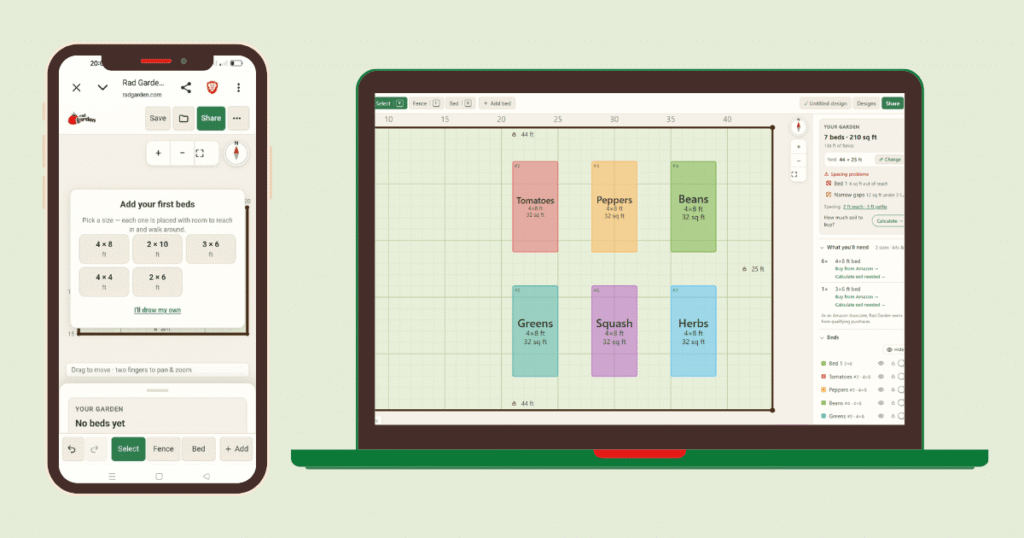
In the planner: Enter your yard size (you can change it anytime), add fences, and use the compass to see which way your garden faces. Everything sits on a 1 ft grid.
Step 2: Keep Every Bed Within Reach
How wide should a raised bed be? The same rule works for in-ground beds. Most people can comfortably reach about 2 ft into a bed, so size every bed around that:
- 4 ft wide if you can walk around both sides.
- 2 ft wide if one side sits against a wall or fence.
In-ground: The same rule applies to wide in-ground beds. If you plant in single rows instead, you work each row from the paths beside it, so keep the planted strip narrow enough to reach from the path.
Raised beds: In a raised bed vegetable garden layout, the frame locks in the width, so get this right before you build. A good raised garden bed layout keeps every bed at 4 ft wide or less. Length is up to you.
Most raised bed garden layout plans stick to a few standard sizes, since that's how kits and lumber are sold. A 4x8 raised bed layout is an easy place to start: 4 ft wide so you can reach the middle from either side, and 8 ft long to match standard 8 ft boards. If you're still deciding what to buy, our roundup of the best raised garden beds compares kits by size and material.
In the planner: There are quick-add buttons for 4x8, 4x4, and 3x6 beds (24" kits), 2x10 and 2x6 beds (12" kits), plus custom or hand-drawn beds. If a bed is too wide to reach, the spacing check flags it.
Step 3: Leave Room for Paths
Plan about 3 ft of path between beds. That gives you room to kneel, turn a wheelbarrow, and move around without stepping into a bed. If you're wondering how far apart raised beds should be, the answer is the same: about 3 ft.
In-ground: Use the same idea for the paths between your rows or beds, so you can walk and work without packing down the soil you plant in.
When you look at vegetable garden layout plans and spacing, keep in mind this is spacing between beds and paths, not between plants. For plant spacing, check your seed packet.
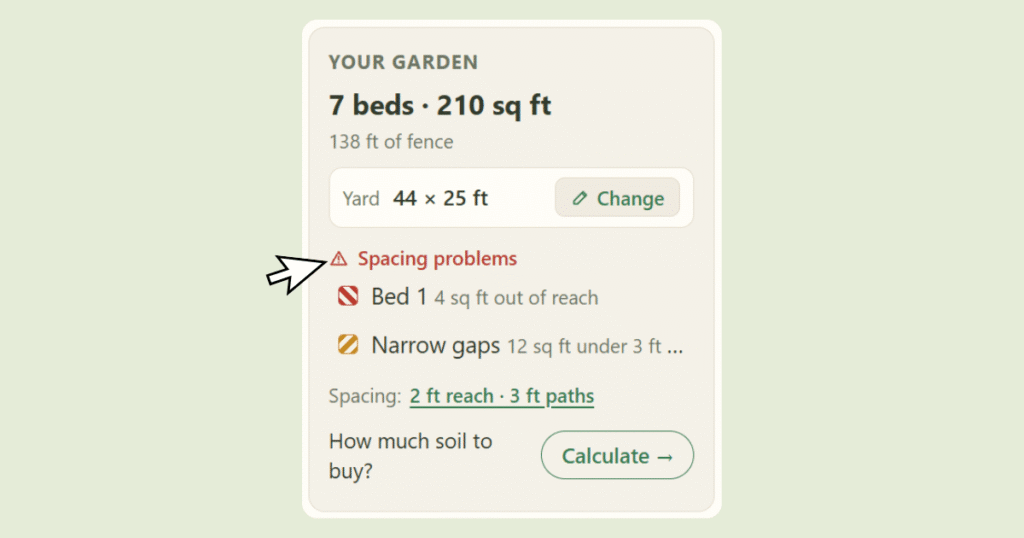
In the planner: The defaults are 2 ft reach and 3 ft paths. You can change them under Spacing rules. The spacing check tells you when a bed is too wide to reach or two beds are too close together, so you catch it before you build. When everything passes, you'll see "Every bed is reachable and every path is 3 ft+."
Step 4: Pick a Layout and Sketch It to Scale
You don't have to design from scratch. These vegetable garden layout ideas are all beginner-friendly:
- Rows: Straight in-ground rows with paths between them. Simple to lay out on a big, open space.
- Grid of beds: Several beds with even paths between them. Simple to build and maintain, in the ground or raised.
- Square-foot bed: A compact starting setup for a first garden.
- U-shaped bed: One bed wrapped around a center path, so you can work most of the bed from the center path.
- Potager: A decorative kitchen garden layout with beds arranged around a center point.
- Border: Narrow beds along a fence or wall, for yards with only a strip of space.
Short on space? A small vegetable garden layout for beginners can be as simple as one or two 4x4 beds with a 3 ft path, or a narrow border along a fence. You can always add beds next season.
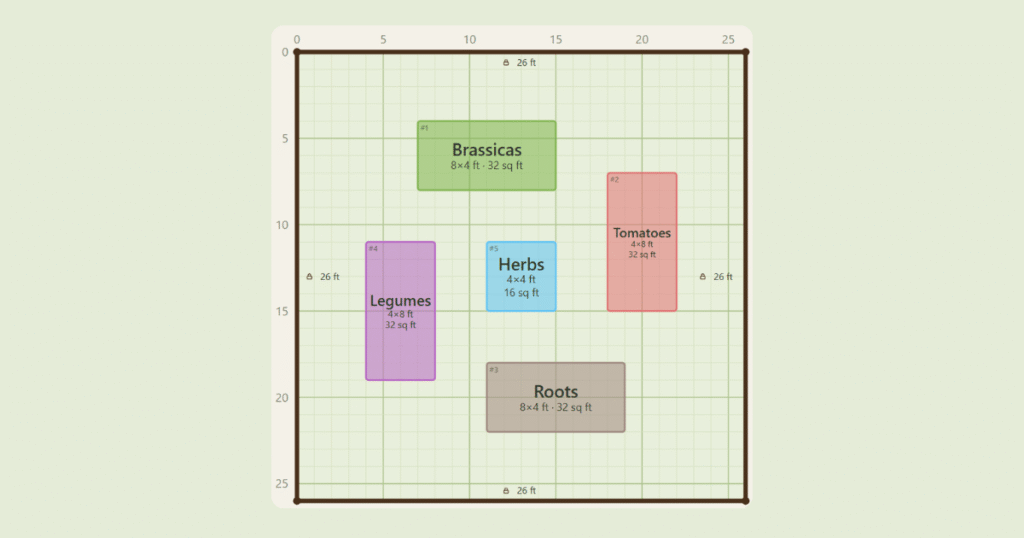
Once you've picked a style, draw it to scale and walk the paths in your head: from the gate, to the hose, to each bed. To design a vegetable garden layout you'll be happy with, fix anything that feels tight now, while it's still just a drawing.
In the planner: The last five styles are ready-made templates (Six Raised Beds, Square-Foot Starter, U-Shaped Bed, Pinwheel Potager, and Small-Yard Border). Drag, resize, name, and lock beds as you test ideas. Your plan autosaves in that browser only, so use the share link or Download picture to take it anywhere.
Step 5: Work Out Your Materials and Soil
Whether you lay out a raised bed vegetable garden or in-ground rows, finish by counting your beds by size. For raised beds, that tells you how many kits or boards to buy and how much soil you need to fill them.
How much soil for a 4x8 raised bed? Multiply length by width by depth in feet. A 4x8 bed filled 1 ft deep needs 32 cubic feet (about 1.2 cubic yards). Filled 2 ft deep, it needs 64 cubic feet (about 2.4 cubic yards). Bulk soil is usually sold by the cubic yard. For other sizes, use our soil calculator, and see our guide to the best soil for raised garden beds for help choosing a mix.
In the planner: The "What you'll need" list groups your beds by size and links to kits. Some of those are Amazon affiliate links. The Epic Gardening modular bed links are not. Click "Calculate" to open the soil calculator with your bed sizes already filled in.
Frequently Asked Questions
What is the best layout for a vegetable garden?
For most beginners, the best garden layout is a simple grid of beds, in the ground or raised, about 4 ft wide (or 2 ft against a wall) with about 3 ft paths between them. It's easy to build, easy to reach, and easy to expand, and the Six Raised Beds template in the Garden Planner gives you a ready-made starting point.
What is the optimal layout for a raised bed garden?
The optimal raised bed layout keeps every bed 4 ft wide or less (2 ft against a wall), with about 3 ft paths between beds, in a simple grid or row that fits your space. Sticking to standard sizes like 4x8 or 4x4 keeps lumber and kits simple, and drawing it to scale first catches reach and path problems before you build.
How much space should be between raised beds?
Leave about 3 ft between raised beds. That's enough room to kneel, move a wheelbarrow, and work without stepping into the beds.
How much soil do I need for a 4x8 raised bed?
A 4x8 raised bed needs 32 cubic feet of soil (about 1.2 cubic yards) to fill it 1 ft deep, or 64 cubic feet (about 2.4 cubic yards) at 2 ft deep. For other sizes, multiply length by width by depth in feet, or use the soil calculator.
What is a recommended small vegetable garden layout for beginners?
Start with one or two 4x4 raised beds and a 3 ft path, or narrow 2 ft beds along a fence if you only have a strip of yard. The Small-Yard Border template in the Garden Planner is a quick starting point, and you can add beds as you go.
Plan It Before You Build It
A vegetable garden layout that works starts with beds you can reach, paths you can use, and a plan that fits your yard. That's true whether you dig rows or build raised beds. Sort it out on screen first, let the planner flag what doesn't fit, and the build becomes the easy part.